
An Essential Guide to Content Marketing Success
Only 37% of B2B brands and 38% of B2C brands have a content strategy, yet content marketing costs 62% less than all other marketing and generates three times the amount of leads (DemandMetric).
Content marketing (a.k.a. Inbound Marketing) is a staple in most marketers bandolier of tactics. In fact, 70% of marketers are actively investing in content marketing now (HubSpot, 2020). From Fortune 500 organizations to small businesses, content marketing allows companies to tell their story and deliver information about their products and services in an interactive and measurable way.
The purpose of this marketing tactic is to create and share relevant written, downloadable and visual media, so your target audience can learn about your brand, expertise, and products or services.
Businesses use it for many reasons including:
- Increase website traffic
- Build trust
- Improve SEO
- Attract buyers
- Showcase solutions
%
Content marketing costs 62% less than all other types of marketing and generates approximately three times the volume of leads.
(source: Demand Metric)
The cliché rings true in this case – content marketing is a marathon, not a sprint. You need to take a longer-term view of how you communicate with your customers. If your customer loves your messaging and product explanations, it means it’s meeting the needs of the people you are trying to reach.
If you talk to any modern-day sales and marketing professional about how they approach it, you’ll most likely hear four things in common. Think of them as “the four pillars,” of content marketing:
- Tell good, compelling stories.
- Be insightful and helpful.
- Leverage data to back-up your claims.
- Offer sage advice, and lots of it.
Content marketing gets three times more leads than paid search advertising. (quoracreative.com)
In this day and age of connectivity and too many choices, B2B buyers are squeezed for time, so they’re interested in useful, educational information that’s easy to access and digest. Video, ebooks, infographics, case studies and educational blogs help buyers compare their efforts and pains with their peers and justify their investment. In fact, 9 out of 10 B2B buyers say online content has a moderate to major effect on their purchasing decisions (Lenati). The most tangible way to link your business to a buyer’s needs is to show how you solve problems better than your competition, while citing results similar companies you’ve worked with have received when they’ve used your products or services.
Build Trust
Establishing thought-leadership and explaining how you approach industry trends and issues helps fuel your automated distribution process and move consumers through the buyer’s journey logically. It’s crucial to align the sales cycle with the buyer’s journey to identify gaps and develop frameworks to help you create effective thought-leadership content. If marketing and sales aren’t on the same page, consistency in your messaging will suffer and consumer trust will be diminished. I explain more about the importance of aligning sales and marketing later in this article.
Keys to Building Trust
- Leverage your thought leaders and product experts to produce informational pieces around their expertise and experiences.
- Address specific issues and pain points in the marketplace and especially your industry in general – answer questions.
- Use landing pages and microsites (content hubs) centered around specific features and benefits to make it easy for buyers to self-educate.
- Monitor user’s website activity through Marketing Software and Lead Scoring to get an accurate view of what content is working and who is looking at it.
- Score your website visitors that interact with your content – Sales can cherry pick hot leads that display buying intentions through their website interaction and flow. For example, a user visits a product feature page, then a case study page, then a pricing page. Timing is everything – 78% of customers buy from the company that responds to their inquiry first (Lead Connect).
Enable Sales While Supporting the Buyer’s Journey
Your content can act as a surrogate for your senior sales people early in the sales process, while scoring the content users engage with and measure their interest. Your “digital thought leader” can demonstrate and share their expertise early in the sales conversation to display solutions and build trust.
As you distribute content and monitor user engagement, you can deliver appropriate information and materials to move prospects closer to purchase. Over time, a bonus effect of quality and trustworthy content will enable you to slowly start moving to a higher position in search engine results.
5 Ways to Use Your Content
- As an Opportunity – What’s your broader mission?
- Explain how your product live in the world and what problems it solves.
- Share Stories – Not self-indulgent stories, but walk in your cutsomer’s shoes and explain how your product has helped them.
- Be relevant to your target audiences – Speak to them, Feature Customer Questions
- Create content in many forms – videos, case studies, whitepapers, slide share, etc.
Use Authentically Conversational Content that Quickly Addresses Early Stage Questions
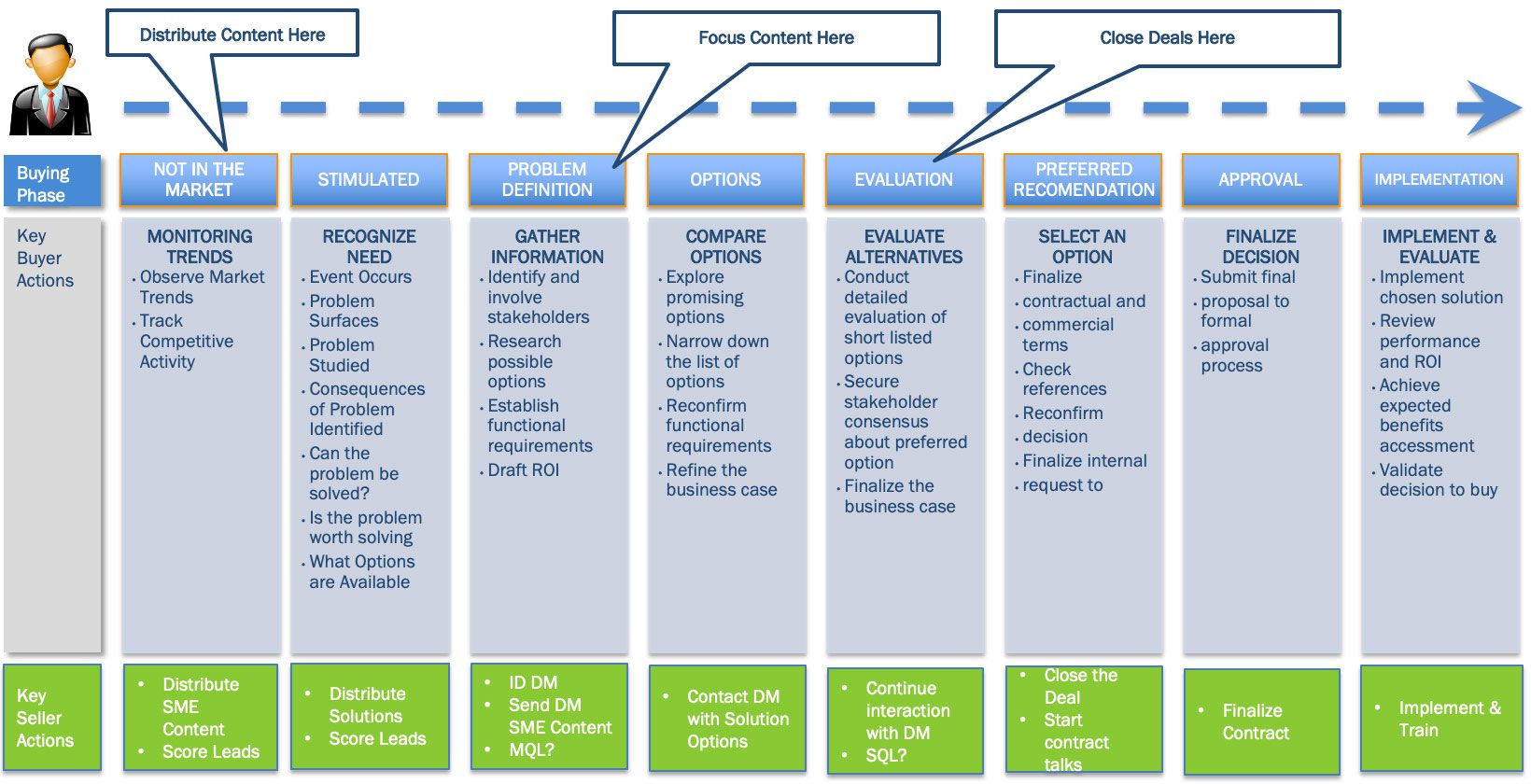
Click image to make it bigger
Be strategic and tell a story that leads people to the point of purchase
We’ve all heard of the “sales funnel” and how it can increase revenue if you use it right. But what does that mean? A sales funnel is basically the steps a prospect takes to become a customer. Some sales funnels are simple, for example the purchase of light bulbs. While others are quite complex such as some enterprise SaaS products or types of medical equipment. No matter what your funnel is, it’s paramount to align marketing efforts with sales processes to move deals towards meeting with thought-leaders and deal closers.
As mentioned above, it’s good practice to align your sales process with your buyer’s journey and use focused content to educate prospects throughout their product exploration. Sales and marketing MUST work together to form the journey, so both parties understand the steps and the content associated with each of them. It’s important for marketing to talk with sales people to understand the buyer and what questions they’re asking and what refusales they’re giving. From this information, marketing can create content that answers the questions (FAQs, blog articles, infographs) and explains the products and services in detail to demonstrate how and where the product fits the market.
Within each step of the process, there are a few different pieces of content that work to tell the story and explain products and services. The graph shows some content suggestion for each stage of a four-step, basic funnel.
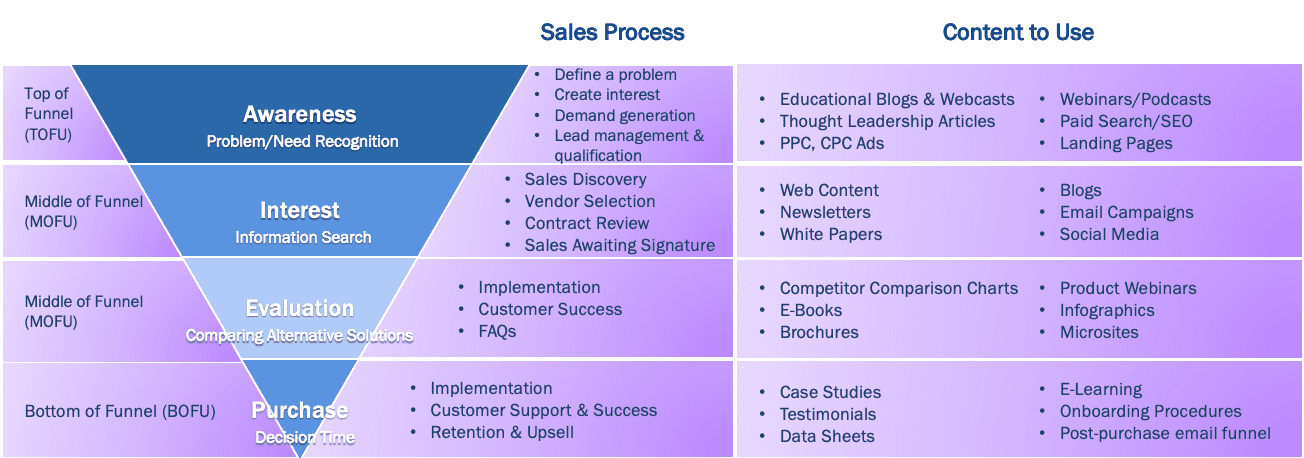
Click image to make it bigger
As marketing works with sales to create information for each step of the process, sales works with marketing, giving them key information they’re hearing on calls, in meetings and from the chatter in marketplace in general. Once the assets and collateral is created, loaded in marketing software and distributed on a consistent basis, marketing can monitor user engagement with the website and the content and pass leads to sales as users:
A. visit key pages and interact with valuable pieces of content that indicate buying behavior,
B. reach a certain score through interacting with website pages and content – in the case of “lead scoring.” See Lead Scoring and Why it’s Important for Businesses.
With the multiple moving parts now involved in reaching targeted audiences with information about your business, both sales and marketing must work together to produce leads, educate them, and move them towards purchasing your product. Marketo finds that companies with an aligned sales and marketing strategy are 67% better at closing deals. Ssales and marketing departments that work together better understand the target audience, the sales cycle and the right content to send an interested prospective buyer when they’re looking for it. This type of sales enablement bridges the communication gaps that can otherwise stifle your brand’s messaging consistency and lead qualification.
“By bringing marketing and sales together and making us more effective as a team, we can build a stronger program to meet advisor needs and achieve business results.” – Mary Rosai, Senior Vice President of Institutional Services Marketing, Charles Schwab [Marketo]
Regardless of the size of your business, the slightest investment in content marketing can return value. Dedicating time, resources and manpower to creating assets and information for potential buyers to learn about your organization and its products and services will ultimately lead to sales. Committing in-house resources such as product team members and company leaders to developing thought-leadership content pieces such as product demonstrations and headshot interview videos can go along way. Such videos can be transcribed and used to create ancillary pieces such as blog articles, white papers, webinars and case studies. Investing in a weekly blog will not only improve SEO, it will establish thought-leadership and keep your firm and its products top of mind with your audience, which will be good for business.